Why Ireland should be taking way more notice of Andy Keogh
Keogh is Ireland’s most in-form striker, and Martin O’Neill should really be taking notice.
Enda Higgins Mar 20, 2017
Keogh is Ireland’s most in-form striker, and Martin O’Neill should really be taking notice.
Enda Higgins Mar 20, 2017
“It should be a great adventure.”
This is how Andy Keogh described his pending move to Australia back in 2014. At the time, the 28-year-old had played for 10 Championship clubs during his 10 seasons in England, including six loan spells. He was now a free agent. With opportunities limited and an international career in limbo after the sacking of Giovanni Trapattoni in 2012, Keogh accepted an offer to be Perth Glory’s marquee signing. He and his family traveled nearly 9,500 miles to make the move.
Journeying to Australia is not a new phenomenon for anyone born in Ireland. The man from South Dublin has joined almost 20,000 Irish people who have moved to Oz since 2012. Australia is always a dream for young Irish people. A culture similar to our own, no language barrier, incredible professional opportunities, and the added bonus of sunshine on Christmas Day. Enjoying beer and BBQs on a sunny beach with friends from home may sound impossible to some, but for many, it’s a reality. However, few Irish people traveling overseas have had as much impact as Keogh.
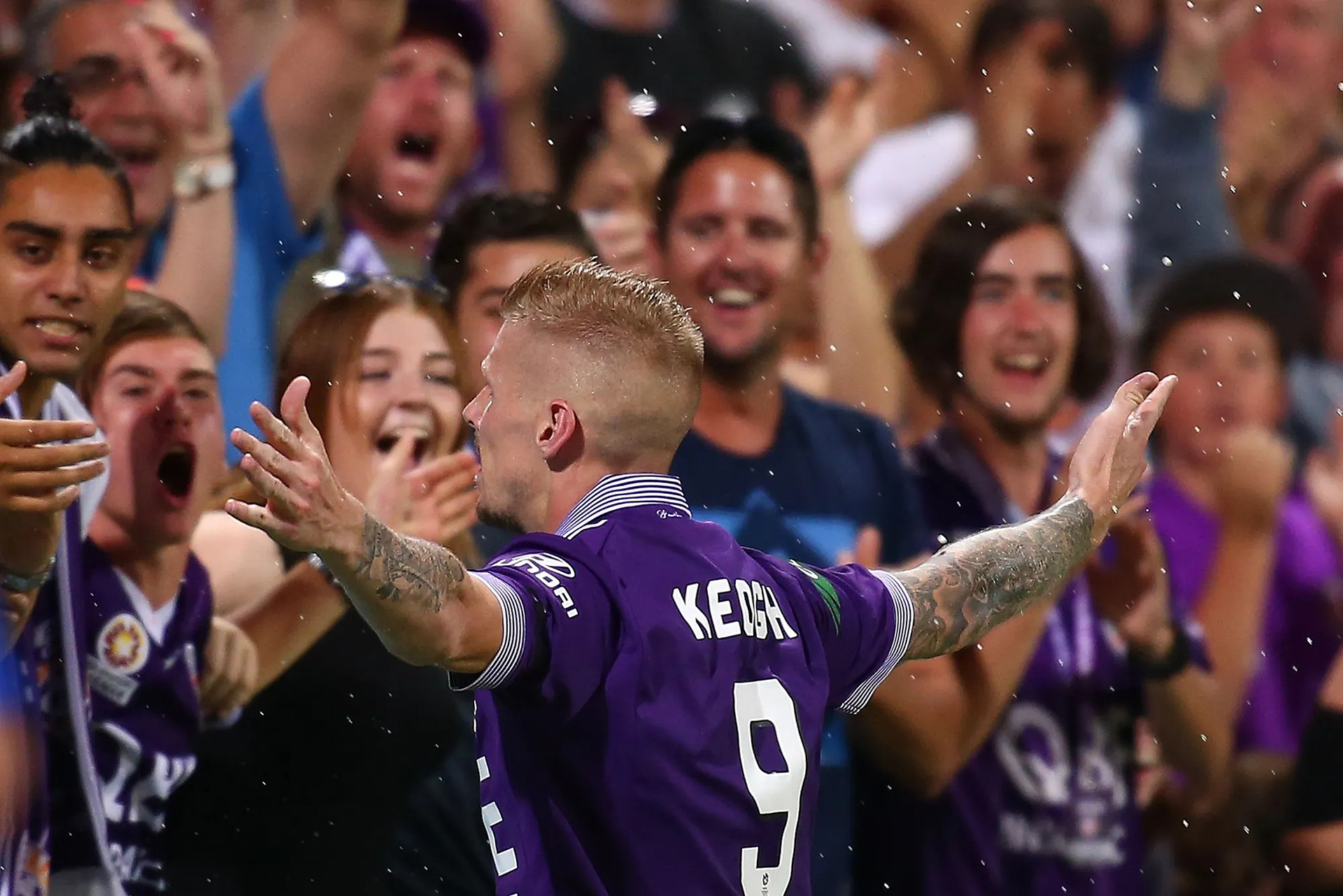
Since joining the Kenny Lowe revolution at Perth, Keogh has been nothing short of phenomenal. The sound of Australian commentators yelling “Key-Oh” as the 6-foot Dubliner scores for Perth Glory has become a regular occurrence on local television. He has 31 goals and 8 assists in 62 appearances. This feat is even more impressive considering Perth experiences some of the hottest temperatures in Australia.
Linking up with fellow marquee signing Diego Castro, they have produced some of the most attractive football in the A-League in the past 3 seasons. Their inability to keep a clean sheet also keeps neutral fans entertained during Perth Glory matches. Their 22 league fixtures this season have produced 83 goals. Castro and Keogh have been responsible for 19 of those.
While Keogh is finally producing the consistency that evaded him earlier in his career, there remains something slightly mystical about him. Everything is a little bit out of the ordinary. He has only 2 goals in 30 appearances for Ireland, but one was against the team that would go on to become World Champions 2 years later, and the other was voted international goal of the season in 2008. He only scored twice in his loan spell with Cardiff City, but both were last-minute goals. He scored twice in his debut for Perth. His first hat trick in Australia came against the reigning champions, Brisbane Roar, and his second was against the star-studded Melbourne City team this season. He’s the first player in A-League history to score in 8 consecutive games. The epitome of the phrase “he makes something happen”: with Keogh, nothing on the football pitch appears dull. Why settle for a simple tap-in when you can lob the keeper from 30 yards out? Keogh has managed both feats against Melbourne’s two teams this season. If Perth Glory is a rock band, then Keogh is the guitarist who lives for the encore. The bigger the crowd, the more impressive and longer his guitar solo becomes.
Yet, it’s a move that hasn’t been without controversy. Late in the 2015 season, Perth were charged with breaching the league’s salary cap rules, and Keogh, as a marquee signing, was among the players investigated. They were immediately thrown out of the play-offs, which occur between the league’s top 6 teams at the end of every season, and fined €200,000. Keogh and members of his family were accused of accepting secret payments in connection with the breach. Something which Keogh denies. This led to a short and uninspiring spell in Thailand. Thankfully, opportunity once again presented itself. Perth had an open marquee spot in January 2016, and Keogh returned to the club. The Australian dream, which had threatened to derail completely, was now back on track. Keogh re-integrated with staff, supporters, and teammates as if he had only been away for a brief holiday. Controversy passed, form remained.
But for many, and probably most importantly, the inevitable questions will remain. Why was he a free agent in England at 28? Where was this consistency 5 years ago? Is football in Australia really a good enough environment for Keogh’s performances to warrant any interest from Roy Keane and Martin O’Neill? Would the travel required be worth the hassle? Would Perth support his decision to return to international football?
These are all valid questions, each with layers of complexity—but we can only deal in facts. Keogh is a 30-year-old in the form of his life, playing in a position that is currently causing significant difficulty for Ireland. Robbie Keane has retired. Shane Long is spending more and more time on Southampton’s bench. Jon Walters will be out for an unspecified length of time after knee surgery in January. Daryl Murphy has also been struggling with muscle injuries this season. All the while, Keogh has remained fit and healthy, performing consistently.
It’s not just the statistics or the eye-catching goals that should be of interest to O’Neill. Keogh’s style of play is everything that this current Irish team needs from a striker. Tireless work rate, fantastic hold-up play, and a diversity to his finishing that England never got to see from Keogh. He has developed into a complete striker and found a team that plays to his strengths. But Irish managers have built reputations for being stubborn. From Andy Reid to Stephen McPhail, there are always players who should be in the squad but aren’t. Their reputations were enhanced with each exclusion. And international hope for Keogh remains, however slight it may be.
"Martin has shown a willingness to look outside the box with some players, and I'd love to show what I could do in a training camp,” said Keogh back in October. He may hope O’Neill looks a little further outside the box soon. Roughly 7,500 miles.
Encore or not, Keogh’s Australian adventure continues to hit all the right notes
------------------------------------------------------------------------------------------------------------------------------------
Omar Abdulrahman — The Prince of Asian football
You may not have heard of him before, but Al Ain’s Omar Abdulrahman may be Asia’s best player.
Enda Higgins Apr 25, 2017
You may not have heard of him before, but Al Ain’s Omar Abdulrahman may be Asia’s best player.
Enda Higgins Apr 25, 2017
The Asian Football Confederation (AFC) recently signaled its intent to become the world’s leading football confederation with the launch of its Vision and Mission. The aim of the AFC is to focus on the success of Asian teams on the world’s biggest stages and to strengthen fan engagement to ensure football remains the number one sport throughout the continent.
The quality of Asian football is no doubt improving. While the influx of cash has certainly put Asian football, and more specifically Chinese football, on the radar of European footballers and agents, there remains a significant concern among national football associations about how this will affect the development of local footballers. Even in highly populated countries, there is skepticism about the quality of homegrown Asian footballers. But there is little doubt about who the best is: 25-year-old Al Ain captain Omar Abdulrahman, widely considered Asian football’s crown jewel.
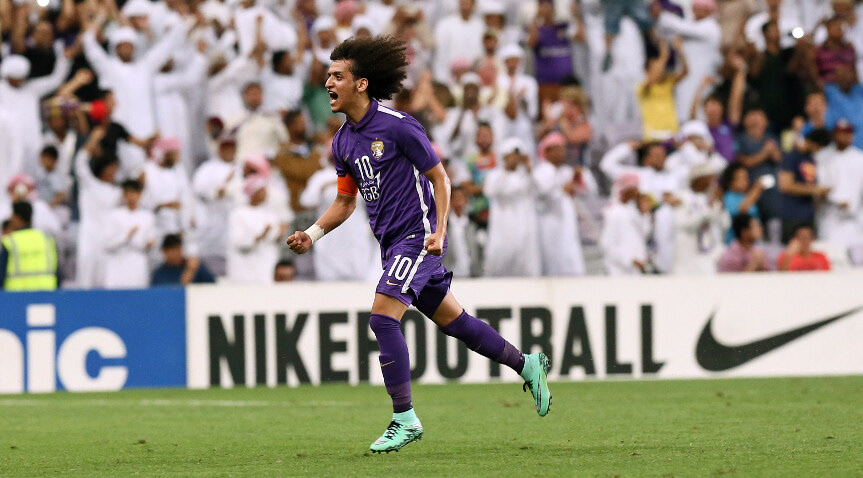
Any attempt to describe Omar’s talent falls short. He plays a different game to everyone else on a football pitch. He stands out like a Ferrari among Nissan Micras. He is the complete modern attacker. Pace, movement, dribbling, passing, goals, assists. No words in the football lexicon can accurately describe him. Italians use the term Trequartista not just to classify someone as a number 10 but to describe a footballer with grace and talent. In that regard, Omar should be the blueprint. But he provides more flexibility than a defined number 10. He has played in every position across Al Ain’s front four; both wings, number 10, and false nine. He drops deep into midfield when his team isn’t in possession, waiting to make his move. There is no set position for him. Team mates search for him at every opportunity, and he inevitably creates the space to launch Al Ain attacks like Napoleon on the battlefields of France.
The stats speak for themselves. 51 goals and 94 assists in 203 senior appearances for Al Ain, many of those appearances coming long before he reached his peak as a footballer. Add to that the countless pre-assists and mesmerising build-up play, all started by the magic left foot of the boy known as “Amoory”.
“I never saw a player like this in Asia,” said the Brazilian forward Leonardo last year, a man also producing impressive displays in Asia at Jeonbuk Motors and now Al Jazira. “I play against Chinese teams, Australian teams, and Japanese teams, and I have never seen one player like this”. It’s the common consensus among all pundits and supporters of Asian football. At his best, he is untouchable.
But with great talent inevitably comes great responsibility. This is seen as the golden generation of UAE football. A team with enough class and profile to finally step out of the footballing shadows and replicate the fairy tale World Cup qualification of 1990. It should be a team storming the gates of success. Omar Abdulrahman, providing the bullets for clinical strikers like Ali Mabkhout and Ahmed Khalil, should instill fear into every national team they face. But their World Cup qualification hopes have been left in tatters after defeats home and away to Australia. A sobbing national coach resigned, and the team is in disarray. This is even more disappointing for UAE supporters, given the excellent football they played to win the 2013 Gulf Cup of Nations—where Omar was named the tournament’s best player. But with the national team’s latest failure, fingers in the media have inevitably been pointed at their golden boy, and like all mercurial talents, they usually take the blame for under-performing teammates.
He faces the same pressure at the club level. The captain of his boyhood club for the last four seasons, he dragged them to the brink of history last October. A nine-month-long Asian Champions League campaign saw Abdulrahman star throughout. They were on the brink of exiting the group stages when he scored a late free kick in their final home game, which proved to be the catalyst for their progression. He impressed again in the knockout stages, providing more crucial goals and breath-taking assists, scoring home and away in the semi-final. They met Korean powerhouse Jeonbuk in the final. The stage was set for Al Ain and Asian football’s biggest talent to show what they were capable of. In the second leg of the final, Al Ain won a penalty to level the aggregate score 3–3. Surprisingly, Brazilian striker Douglas, not Omar, took the penalty and blazed it over the bar. Jeonbuk held on for the victory, and Al Ain still hasn’t recovered from the loss six months later.
Omar's decision not to take such a crucial penalty was seen by many as a captain shirking his responsibilities and failing to step up in the big moment. Logic would simply suggest that a striker taking a penalty is the normal routine, but the fact that Omar has taken every penalty at the club since then has done little to diminish criticism. It’s the nature of football fandom and punditry. Take aim at those lauded for their skill and hope for their failure rather than appreciate their talent. If such a moment presented itself again, there’s no questioning who would step up.
The next dilemma for Omar is perhaps the most obvious of all. Will there be a move to Europe? The ultimate test for every overseas footballer, according to those in European football, anyway. Manchester City came calling after his impressive displays at the 2012 Olympics, and he was offered a contract following a successful trial, but his refusal to sign was attributed to work permit issues - although most believed it was just too soon for the 21-year-old at the time. To understand why he hasn’t made the move, look beyond the game. Financially, he is secure; he is treated like royalty at home; and he has two brothers who play with him in Al Ain. It’s a situation impossible to replicate at any other club. It is very hard for an Emirati player to adapt to life outside their home, and even someone as skilled as Omar Abdulrahman risks tarnishing their reputation. He has already cited Arsenal as being a club he feels he would be a good fit for. There are also links to Barcelona after he faced them in a friendly in December.
For now, we will just have to admire Omar’s brilliance from a distance, but should he eventually make the move to Europe, then the world would truly be introduced to Asia’s greatest player.